


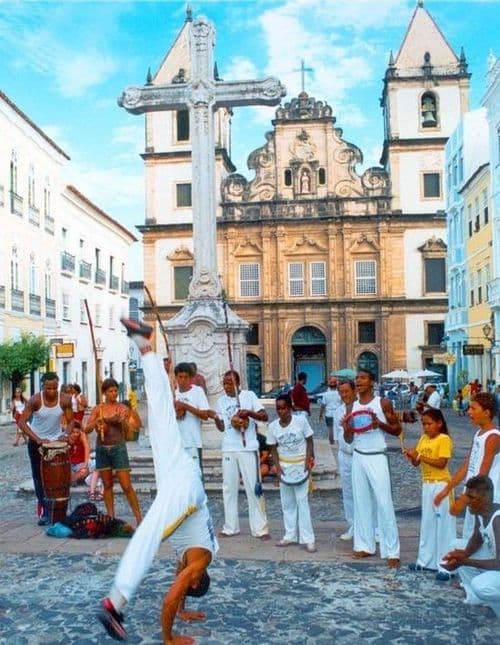


You book at no cost and, at the end of the tour, you tip the guide whatever you think is fair. Vivai charges you nothing.
Included Services
No transport needed
The meeting point is the experience location itself, so you do not need transport to take part.
Travel insurance included
Every Vivai experience already includes travel insurance, at no extra cost.
What you will do
• FREE WALKING TOUR PATHS OF RESISTANCE A two-hour Afro-centric tour in the Historic Center of Salvador (Pelourinho), the blackest city outside of Africa and the beating heart of Afro-Brazilian culture. Let's discover together more of the stories that traverse the layers of time, with a version of history that few know. Barroquinha Cultural Center A place of resistance and celebration of Afro-Brazilian culture, the Barroquinha Cultural Center is the ideal starting point. Housed in an old church, it is now a space for art, memory, and encounters that revere the ancestry of black women, through the creation of the sisterhood of Our Lady of Good Death, where the first Candomblé terreiro (religious center) in Brazil was born. The Festa da Boa Morte (Festival of Good Death) is a religious and cultural celebration held annually in Cachoeira, in the Recôncavo Baiano region, in honor of Our Lady of Good Death. Organized by sisterhoods composed of Black women, the festival blends Catholic faith with Afro-Brazilian traditions, reflecting the historical resistance of the Black population against slavery. The event includes processions, masses, dances, songs, typical foods, and traditional costumes, highlighting the role of the sisterhoods in the spiritual and social life of Afro-descendant communities. It is a striking expression of Brazilian cultural identity and diversity, and the festival is a Historical Heritage site. After discussing the sacred, we move on to the profane, walking through Castro Alves Square, a tribute to the "poet of the slaves." The stage for Salvador's carnivals, with the parade of Afro-Brazilian percussion groups, where these groups transcend generations, resisting prejudice and showing where our carnival culture in the streets is born. The first street in Brazil, where the colonial past blends together, the scene of a bombing in 1912 due to a political disagreement, the period of whitening the race, the city develops through the construction of roads, avenues, and new heritage sites. We arrive at the Municipal Square, highlighting the Town Hall and Jail, where several leaders of the main revolts that occurred in the city were imprisoned, next to the Ladeira de Revoltas dos Malês (Malês Revolt Hill), the largest slave revolt in Brazil. Misericórdia Street, where the city's first hospital was born, the Santa Casa de Misericórdia Hospital, a philanthropic institution, where there was an orphanage and at the door was the wheel for foundlings and excluded children, mothers who could not afford to raise their children left them at the wheel and the nuns took them in, today a museum that tells this and many other stories from that time. Memorial das Baianas tells the story of the resistance, strength, and determination of these women who possessed this culinary knowledge. Before abolition, these women sold their snacks and, at the end of the day, offered the money to their masters. After the abolition of slavery, where these women were not socially represented, they continued in their stalls selling their snacks and supporting their families. We have a very strong street food culture, the main one being acarajé, a reinterpretation of the food of the orixás. Monument to Zumbi dos Palmares, a tribute to the leader of the Quilombo dos Palmares, a symbol of black resistance, the last leader of the largest and most resilient quilombo in Brazilian history. His death on November 20, 1695, three hundred years later, was established as Black Awareness Day. The history of the quilombo begins with the story of Aquatunes, Zumbi's grandmother. At Praça Quinze de Novembro, Bar do Cravinho, the space was born from the desire to share the alcoholic infusions that had been consumed by the owner's family for generations. These drinks mix cachaça with herbs, fruits, and roots, such as cloves, honey, lemon, jatobá, and others, rescuing knowledge from Black and Indigenous ancestry. Traditionally, they store the drink in oak barrels, all handcrafted. In Largo do Cruzeiro de São Francisco, Sociedade Protetora dos Desvalidos (Society for the Protection of the Disadvantaged), the first civil society composed of Black men in Brazil, helped their brothers buy their freedom papers after abolition, helped their brothers integrate into society, at that time they already lent money at interest, held lotteries, all organizational models that served as a model for the founding of the Caixa Econômica Federal Bank. The entity still exists and continues to promote social and cultural actions aimed at valuing the Black population and preserving its history. Rua do Maciel de Baixo, now Rua Gregório de Matos, is named in honor of the poet known as Boca do Inferno (Mouth of Hell). This was a low-class red-light district until it was revitalized in the 1990s, where most of the families who lived there were evicted, and others were compensated, but with such low compensation amounts that it wasn't even enough to buy a decent house. Last year, the government delivered some apartments on Rua das Portas do Carmo to some families who were wronged at that time as a form of social redress. Afoxé Filhos de Gandhi, the desire of the dockworkers of the port of Salvador, 1949, even before the emergence of the electric trio, engaged in social struggles, they decided to honor Mahatma Gandhi, the Indian leader who had been assassinated a year before the founding of the group, they symbolize peace. They bring the tradition of Afoxé, taking the rites from the Candomblé terreiros and bringing them to the streets. Today, it is in the Guinness Book of Records as the largest Afoxé group in the world. At its headquarters, it is possible to see this mixture of religious syncretism that is still so strong in the city. José de Alencar Square, named after the 19th-century writer whose most notable poem was Iracema, the Virgin of the Honey Lips, which brought prominence to the story of an indigenous woman, a great audacity for the time. This square also housed the whipping post that served as punishment for the exiled and enslaved of the time, and the Gastronomy Museum, where part of the wall that defended and protected the city is preserved. Casa de Benin, the museum holds a large religious, political, and cultural collection from the Benin region in Africa, making this link with the similarity in Salvador. The museum was conceived by the French photographer and anthropologist Pierre Verger. Throughout the walk, surprises always arise: processions, personalities, cultural parades; we are always surprised on the journey. Our tour is always conducted with listening and respect; come and discover the history that has never been told to you, come and be moved on this walk.
2 horas de duração
5 km de caminhada
Included Services
No transport needed
The meeting point is the experience location itself, so you do not need transport to take part.
Travel insurance included
Every Vivai experience already includes travel insurance, at no extra cost.
Meeting point
Praça Castro Alves - Centro, Salvador - BA, 40020-160, Brasil
Get directions on Google Maps
Learn more about
IARA CAROLINE
Member since agosto de 2026
Olá! Sou Iara Caroline, Bacharel em Turismo e Guia de Turismo, com uma trajetória dedicada a transformar sua vivência em experiências inesquecíveis. Com uma sólida formação acadêmica em Turismo e anos de atuação prática, construí uma carreira pautada na excelência, empatia, ética e profundo conhecimento cultural, com uma equipe apaixonada, para oferecer o melhor, com todo conforto e segurança.
Olá! Sou Iara Caroline, Bacharel em Turismo e Guia de Turismo, com uma trajetória dedicada a transformar sua vivência em experiências inesquecíveis. Com uma sólida formação acadêmica em Turismo e anos de atuação prática, construí uma carreira pautada na excelência, empatia, ética e profundo conhecimento cultural, com uma equipe apaixonada, para oferecer o melhor, com todo conforto e segurança.
You book at no cost and, at the end of the tour, you tip the guide whatever you think is fair. Vivai charges you nothing.